
No matching category. Contact our team for custom tool development.
Choosing Left Handed Hairdressing Scissors is about more than finding a pair labeled “left-handed.” The blade arrangement should let your left hand close the scissors naturally, with a clear view of the cutting line. Otherwise, the blades may push hair away or require awkward wrist movement. Small differences matter.
Start with fit. Hold the scissors as you would during a real cut, and notice whether your thumb moves freely without stretching. An offset handle can reduce strain for some stylists, while a classic handle may feel more familiar to others. Neither design suits everyone. Your hand size and cutting technique matter.
Blade length deserves a practical check. Shorter blades can feel controlled around fringes and detailed sections; longer ones may help with broader, straight cuts. Consider your usual work, not just a number on a product page. Sharpness and smooth movement matter, too. The blades should meet cleanly without pulling hair, and the tension should adjust without feeling stiff. Test them on a small section, if possible.
Materials and maintenance affect how scissors perform over time. Stainless steel is common, but construction quality and regular professional sharpening also make a difference. A premium price does not guarantee a comfortable fit. That is easy to forget.
A good choice should feel balanced after several minutes, not only during a quick try. Pay attention to pressure around your thumb, wrist, and fingers. If discomfort appears, reconsider the size or handle style before blaming your technique. These details can seem fussy. They are not. The right pair supports steady, precise work, though finding it may take a little trial and honest reflection.
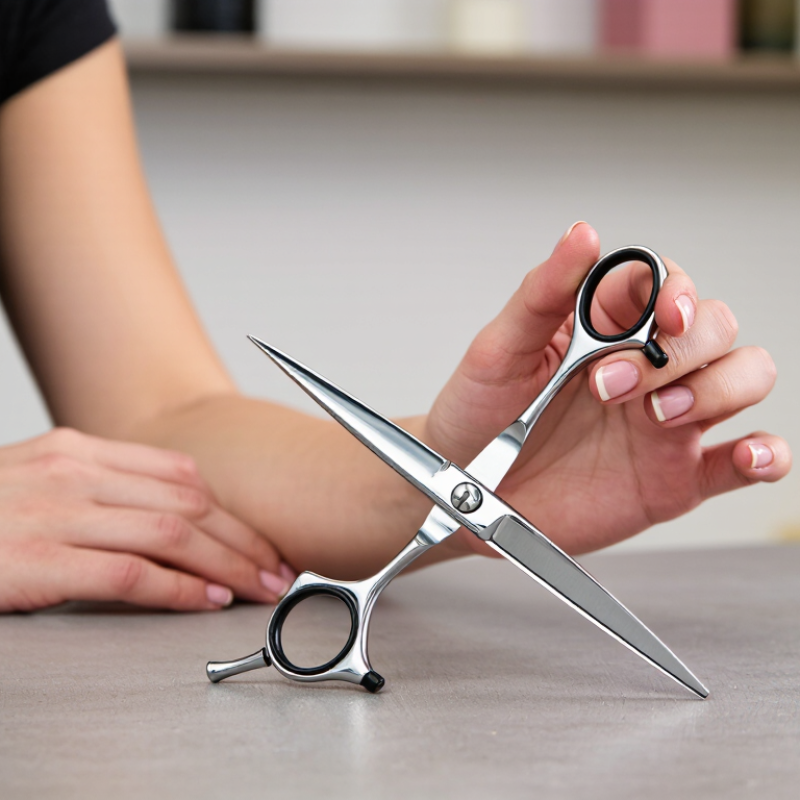
True left-handed hairdressing scissors have blades arranged as a mirror image of right-handed shears. When held in the left hand, the thumb controls the upper blade, while the fingers guide the lower one. This reversed alignment lets the cutting edges meet cleanly under natural left-hand pressure. The blades should not simply look symmetrical; their overlap matters.
Check the scissors in your own hand. Place your thumb in the smaller loop and your fingers in the larger one, then close the blades slowly. You should see the cutting line clearly rather than having your hand block it. Watch the blades meet from pivot to tip, without a gap or sideways twist. Try a small, clean section of hair and notice whether it cuts smoothly instead of folding or pushing strands away. A comfortable grip alone is not proof. The first test may feel awkward; hand position can disguise a poor fit. Inspect the blade alignment, then test again with a relaxed wrist.
For many salon tasks, 5.5- to 6.0-inch shears offer a useful balance of control and reach. This range is common, but “standard” does not mean right for every hand. A shorter pair may feel easier when detailing around the ears or working with compact sections. A 6-inch pair can cover more hair with each stroke and may suit scissor-over-comb work. Small details matter. Measurement methods can vary, so check how a seller measures the shears before comparing sizes.
With left-handed shears, length is only part of the fit. The blades must be designed for a left-handed grip, and the handles should let your thumb move without strain. Hold the shears as you would during a haircut, then open and close them gently. Notice whether the tips feel steady and whether your fingers stay relaxed. A size that feels comfortable on a display table may feel different after several minutes of cutting. That’s easy to overlook. If possible, test a 5.5-inch and a 6-inch pair on a training head, using the same section and cutting motion. Your preferred length may depend on hand size, technique, and the kind of work you do most.
When choosing left-handed hairdressing scissors, steel hardness is a useful starting point, not a verdict. Professional shears often fall around 58–62 HRC on the Rockwell C scale. HRC measures resistance to indentation, not cutting quality by itself. A well-ground blade at 59 HRC may feel smoother than a poorly finished blade at 62. Small differences matter less than blade alignment and edge finish. Check the published specification when available.
For salon use, 58–60 HRC can offer a practical balance between edge retention and easier maintenance. Shears at 60–62 HRC may hold a fine edge longer, but can be less forgiving if dropped or sharpened poorly. These are tendencies, not guarantees. Steel composition, heat treatment, blade geometry, and sharpening all affect performance. Don’t chase the highest number. Look closer.
Hold the left-handed model in working position and, if possible, test it on a clean section of damp hair. The blades should close evenly without pushing hair forward or requiring a hard squeeze. Check tension adjustment, handle comfort, and whether the edge suits your cutting style. I wouldn’t judge hardness from a sales description alone; ask for the HRC range and appropriate sharpening guidance.
| Hardness (HRC) | General Characteristics | Typical Trade-Off | What to Check for Left-Handed Use |
|---|---|---|---|
| Below 54 | Relatively softer steel; generally easier to sharpen. | The edge may need more frequent maintenance, depending on use and blade design. | Confirm the blades and handles are designed for left-handed cutting, not merely labeled ambidextrous. |
| 54–57 | A common moderate-hardness range for general-purpose scissors. | Often offers a practical balance of edge maintenance and resistance to damage; performance also depends on steel and heat treatment. | Check that the blade orientation lets the left hand see and guide the cutting line comfortably. |
| 58–62 | A range often found in professional hairdressing shears. | Can support good edge retention, but harder edges may be more sensitive to impacts, poor adjustment, or unsuitable sharpening. | Verify left-handed blade geometry and smooth adjustment; hardness alone does not make a shear suitable for left-handed cutting. |
| Above 62 | A higher-hardness specification that may be used in some specialized tools. | Results vary with the steel, heat treatment, and blade construction; a higher number does not automatically mean better cutting performance. | Ask whether the shear is intended for salon use and whether a qualified sharpener can service its edge profile. |
Note: HRC is a measure of hardness, not a complete measure of quality. Published values are general guides; actual performance depends on steel composition, heat treatment, blade geometry, maintenance, and cutting technique.
Choosing left-handed hairdressing scissors means checking the blade orientation, handle shape, and tension in your own hand. A true left-handed design lets your thumb close the moving blade naturally, rather than pushing it across the other blade. Hold the scissors as you would during a real cut. Your wrist should stay fairly straight, and your thumb should move without stretching or rubbing against the ring. Comfort is measurable. A handle that feels fine for one minute may pinch after an hour.
The European Agency for Safety and Health at Work reported in 2019 that about three in five workers experienced musculoskeletal complaints. That figure covers many occupations, not hairdressers alone, but it makes repeated hand strain worth taking seriously.
Test the tension by opening and closing the blades slowly; they should move smoothly without snapping shut or needing a hard squeeze. Then make several short cuts on a hair swatch. Listen for an even cutting sound and notice whether your fingers tire. A little resistance can feel reassuring, though too much may increase effort. I once assumed a larger thumb ring would always feel better. It did not. Check whether your thumb sits comfortably, with room to move, and reassess after a full practice session.
Left-handed scissors should have blades designed for left-hand use, not merely reversed handles. Check the cutting edges in your normal grip: the blades should meet cleanly, without forcing your thumb or twisting your wrist. Convex edges often feel smooth and precise, while bevel edges can be more forgiving for everyday cutting. Neither is automatically better. Match the edge to your technique, hair texture, and sharpening access.
Read the warranty before buying. Look for written coverage of blade alignment, defects, and service, plus clear exclusions for routine wear or improper sharpening. Ask whether your local sharpener can work on that edge and whether the service preserves left-handed blade geometry. Small detail, big difference. The UK Health and Safety Executive’s hairdressing guidance identifies repetitive movements and awkward postures as workplace risks; comfortable grip and balance deserve attention, too. The U.S. Bureau of Labor Statistics reported 2.6 million nonfatal workplace injuries and illnesses in private industry in 2023, or 2.4 cases per 100 full-time workers. That figure is not hairdresser-specific, so treat it as a broad workplace benchmark, not proof that one scissor design prevents injury. A fitting test still matters.
HRC measures resistance to indentation, not cutting quality by itself. Professional shears often rate around 58–62 HRC.
No. Blade alignment, edge finish, steel, and sharpening also affect performance. Don’t chase the highest number.
Around 58–60 HRC can balance edge retention with easier maintenance. Shears at 60–62 HRC may hold a fine edge longer, but can be less forgiving if dropped or poorly sharpened.
Hold them in your working position. Your thumb should close the moving blade naturally, rather than push it across the other blade.
Your wrist should stay fairly straight, and your thumb should move without rubbing or stretching. A larger thumb ring isn’t always more comfortable.
Open and close the blades slowly. They should move smoothly, without snapping shut or needing a hard squeeze. Listen for an even sound.
If possible, make several short cuts on a clean, damp hair swatch. Notice whether the blades cut evenly or push the hair forward.
Check for pinching, thumb fatigue, or a need to squeeze hard. One minute may not tell you enough; try a full practice session.
Choosing Left Handed Hairdressing Scissors starts with confirming that the blades are genuinely designed for left-handed use. Their reversed blade alignment helps maintain a clear view of the cutting line and allows the blades to close naturally in the left hand. Next, consider the length: 5.5- to 6.0-inch shears are common salon options, while the best size depends on your hand, cutting style, and intended use.
Steel hardness is another useful comparison point; professional shears often fall within 58–62 HRC, balancing edge retention with durability. Check that the handle shape feels comfortable, the finger fit is secure, and the tension can be adjusted smoothly. Finally, compare edge types and confirm that the scissors can be serviced by a compatible sharpener. Reviewing the warranty and maintenance requirements before buying can help you choose a practical, comfortable pair for regular salon work.