
No matching category. Contact our team for custom tool development.
Eyebrow Tweezers may be small, but their quality is easy to notice. A tip that fails to meet evenly can miss fine hairs. Excessive tension can make repeated grooming uncomfortable. For buyers, beauty brands, and distributors, these details turn supplier selection into a practical quality decision.
The wider market offers useful context, though it does not measure tweezers alone. McKinsey’s 2023 State of Beauty report estimated that the global beauty market could reach about $580 billion by 2027, with roughly 6% annual growth. That forecast signals sustained demand for beauty products, not a specific growth rate for eyebrow tools. Public, comparable data focused only on eyebrow tweezers remains limited. That gap matters.
China has a broad network of personal-care tool manufacturers, but factory capabilities differ. A careful comparison should look beyond price and polished product photos. Check the consistency of tip alignment, steel specifications, surface finish, hinge tension, packaging, and inspection procedures. Ask whether samples are tested across multiple production batches. A single excellent sample proves little. Small details count.
This guide introduces ten Chinese manufacturers and highlights practical points buyers can verify, including product range, customization, production information, and quality-control evidence. Treat each listing as a starting point, not an endorsement. Where details are unavailable, confirm them directly with the supplier. Even a neat catalog can leave important questions unanswered.
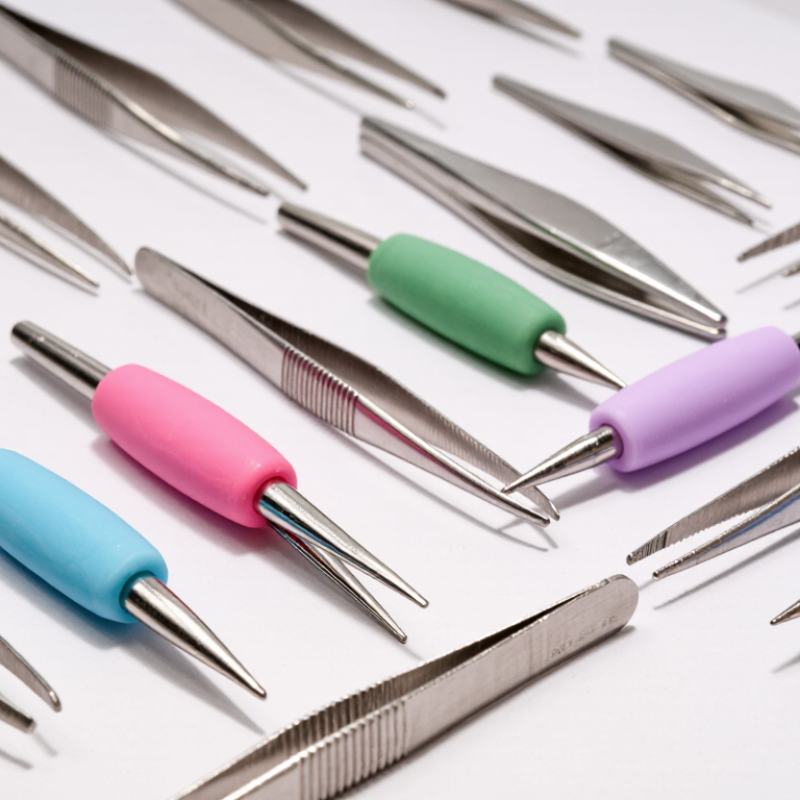
Eyebrow tweezers look simple, but their performance depends on precise contact between two narrow tips. Slanted tips suit broader shaping, while pointed tips can grasp fine hairs. Stainless steel is common because it resists corrosion and can be cleaned easily. Still, the label alone tells little. Tip alignment, spring tension, and surface finish matter more in daily use.
China’s manufacturing industry includes large factories and smaller specialist workshops. Production may involve stamping or machining steel, heat treatment, polishing, tip grinding, and final assembly. Skilled workers often check whether the tips meet evenly under light pressure. Some suppliers also offer different finishes, lengths, and packaging for wholesale orders. Small details matter. A smooth, attractive finish cannot compensate for tips that slide past each other.
When comparing manufacturers, buyers can ask for material specifications, sample units, inspection methods, and clear production timelines. Testing a sample on a fine thread or a single hair can reveal uneven grip quickly. Photos are useful, but they do not show spring feel or edge consistency. Not every batch is perfect. Even careful production can leave small differences, so reliable suppliers should explain how they inspect products and handle defects. Any “top ten” list is most useful when its criteria are transparent, rather than based on broad claims about a factory’s size or location.
When comparing eyebrow tweezers manufacturers in China, look beyond catalog photos. Ask about steel grade, tip shape, production capacity, and quality checks. For slanted tips, inspect whether both edges meet evenly under bright light. The tips should close without a visible gap or wobble. Small gaps matter. Request samples from different production batches, not just a handpicked pair.
Tips: Test several samples on fine hair or thread. Check grip comfort and whether the tips stay aligned after repeated use. Ask for inspection records and clear defect criteria. A polished catalog can still hide uneven finishing; photos alone are not enough. Ask for proof.
Review the manufacturer’s production process and how it handles material changes or faulty batches. Confirm that finished tweezers receive checks for alignment, surface marks, and smooth edges. Discuss packaging to prevent tips from bending during shipping. Ask how sample results can be matched to later orders. A factory visit or independent inspection can provide useful evidence, though neither guarantees every batch will be perfect. Some details are easy to overlook.
Profiles of ten Chinese eyebrow-tweezer manufacturers are most useful when they reveal production strengths, not just polished catalog photos. The profiles can cover stamping, tip grinding, alignment, polishing, coatings, small-batch production, OEM work, packaging, inspection, and export support. Small details matter. A tweezer that closes evenly at the final millimeter is more useful than one with a shiny surface.
Compare material declarations, sample consistency, inspection methods, lead times, and defect handling. Ask whether tip alignment is checked across batches, not only on one showcase sample. China’s National Bureau of Statistics reported that manufacturing value added grew 6.1% in 2024. The figure appears in its Statistical Communiqué on 2024 National Economic and Social Development. It describes manufacturing broadly, not eyebrow-tweezer output.
Profiles should distinguish precision-tool specialists from broad personal-care factories, smaller workshops, and export-focused OEM producers. Check for burrs near the tips and uneven coatings after repeated cleaning. Request dated inspection records and samples from multiple production batches. I would still verify supplier claims independently; glossy catalogs can hide inconsistent alignment. Fit varies.
A material reference for comparing stainless-steel grades relevant to eyebrow tweezer manufacturing. These figures are typical values, not measurements from specific manufacturers.
Density values are approximate and may vary slightly by specification and supplier. Source basis: commonly published material-property data for stainless-steel grades.
Behind a reliable pair of eyebrow tweezers is a controlled process: steel selection, blanking, heat treatment, grinding, polishing, assembly, and inspection. Stainless steel is widely used for its corrosion resistance and durability. The International Stainless Steel Forum reported global stainless-steel production of about 58.4 million tonnes in 2023. That scale supports material availability, but it does not prove a tweezer’s grade or consistency. Small details matter.
Manufacturers should verify incoming steel through material certificates and, where needed, testing; a magnet alone cannot identify the alloy. The arms need even spring tension, and the tips should meet without a visible gap under light pressure. Grinding and lapping create that contact. Polishing removes burrs, but too much can round the point. It happens.
Useful controls include documented checks under ISO 9001, attribute sampling guided by ISO 2859-1, and corrosion testing using ISO 9227 when relevant. These standards support repeatable processes; they do not certify every pair automatically. Buyers can request tip-alignment limits, hardness records, test conditions, and lot-level inspection results. I would still examine samples by hand: paperwork can miss a slightly twisted tip.
This is a manufacturer-evaluation guide, not a verified ranking or a claim about any specific supplier. It summarizes common manufacturing options and relevant quality checks; actual materials, processes, and certifications should be confirmed with each manufacturer.
| No. | Capability Area | Common Manufacturing Process | Typical Materials or Finishes | Useful Quality Checks | Relevant Standard or Reference |
|---|---|---|---|---|---|
| 1 | Blanking and forming | Cutting or stamping metal blanks, followed by forming the arms and basic tweezer shape. | Stainless steel sheet; grade and thickness depend on the design and required spring action. | Check blank dimensions, edge condition, symmetry, and visible cracks or deformation. | Approved product drawings and documented incoming-material specifications; no single international standard defines all tweezer dimensions. |
| 2 | Tip shaping and grinding | Grinding, milling, or precision filing to create slanted, pointed, or flat gripping tips. | Stainless steel; tip geometry is selected for the intended use. | Inspect tip profile, edge condition, left-to-right alignment, and contact across the gripping surface. | Inspection against an agreed drawing, sample, or measurable tip-alignment specification. |
| 3 | Heat treatment | Controlled hardening and tempering may be used when the selected steel grade and product design require it. | Some martensitic stainless steels, such as 420 stainless steel, can be hardened by heat treatment; austenitic grades such as 304 are not hardened in the same way. | Where heat treatment is specified, verify hardness and check for warping or brittleness. | Material-specific process requirements and an agreed hardness method; heat treatment is not appropriate for every stainless-steel grade. |
| 4 | Tip matching and calibration | Manual or fixture-assisted adjustment of the arms so the tips meet consistently under light pressure. | Formed stainless steel, with spring characteristics determined by geometry and material. | Test tip-to-tip contact, gripping consistency, arm return, and operation over repeated cycles. | Buyer-approved functional test criteria, including any specified contact-area or cycle-test limits. |
| 5 | Deburring and surface polishing | Mechanical deburring, belt finishing, tumbling, or polishing to remove sharp burrs and improve surface appearance. | Brushed, satin, or polished stainless-steel surfaces. | Inspect for burrs, scratches, pitting, sharp unintended edges, and finish consistency. | Visual inspection under agreed lighting conditions and surface-finish requirements in the product specification. |
| 6 | Passivation and cleaning | Cleaning and, where specified, chemical passivation of stainless-steel surfaces after fabrication. | Stainless steel; passivation suitability depends on the alloy and process controls. | Check cleaning residues and verify the passivation process using the method agreed for the product. | ASTM A967/A967M covers chemical passivation treatments for stainless-steel parts; it does not by itself certify a finished tweezer. |
| 7 | Decorative coating or coloring | Optional coating or coloring process, followed by curing where required by the coating system. | Coated or colored surfaces over a suitable base material; coating type should be disclosed and specified. | Check color consistency, adhesion, coverage, and wear at frequently handled areas. | Use coating-specific test methods and acceptance limits agreed between buyer and supplier; requirements vary by coating chemistry. |
| 8 | Corrosion-resistance verification | Optional exposure testing on finished parts or representative samples, based on product and market requirements. | Stainless steel, with corrosion performance affected by grade, finish, contamination, and exposure conditions. | Record test conditions and inspect specimens for specified signs of corrosion after exposure. | ISO 9227 specifies salt-spray test methods. Salt-spray results do not directly predict service life in every real-use environment. |
| 9 | Final inspection and sampling | Visual, dimensional, and functional checks performed on finished goods; sampling may be used for defined characteristics. | Completed tweezers in the specified material, finish, and packaging configuration. | Check dimensions, tip alignment, opening and closing action, appearance, and packaging against the approved specification. | ISO 2859-1 provides sampling plans indexed by acceptance quality limit (AQL); the buyer and supplier must agree on the plan and limits. |
| 10 | Quality-system and traceability controls | Documented control of orders, materials, production checks, nonconformities, and corrective actions. | Material certificates or supplier records may be retained where required by the purchase specification. | Review inspection records, lot identification, complaint handling, and traceability appropriate to the order. | ISO 9001:2015 specifies requirements for a quality management system; certification does not guarantee the performance of a particular tweezer model. |
Comparing eyebrow tweezer manufacturers in China starts with your sales model. A salon buyer may value consistent grip and quick replenishment. A retailer may need several finishes, retail-ready packaging, and stable unit costs. A private-label project may require custom dimensions or logo placement. Define the use case before requesting quotes.
Ask suppliers for samples from regular production, not only polished display pieces. Check whether the tips meet evenly under light pressure. Test grip on fine hairs, inspect the edges, and note any wobble after repeated use. Small detail. Big consequence. Request written specifications for steel grade, finish, packaging, and inspection criteria. A low quote means little if these details remain unclear.
Compare minimum order quantities, sample fees, production time, and reorder terms against your forecast. Ask how defects are recorded and what happens when a batch falls outside agreed specifications. A factory visit or third-party inspection may help when order volumes justify the cost. Still, no checklist removes every risk. Samples can differ from later batches, and delivery estimates can shift. Leave room for a small trial order before committing to broader distribution.
The tips should meet evenly under light pressure. Try gripping one fine hair or thread. Small gaps matter.
Slanted tips suit broader shaping. Pointed tips can catch finer hairs. The better choice depends on the task.
No. Check tip alignment, spring tension, and surface finish too. A shiny coating proves little.
Production may include stamping or machining, heat treatment, polishing, tip grinding, and assembly. Each step can affect the final grip.
Request samples, material details, inspection methods, and defect-handling information. Ask for samples from multiple batches, not just one.
Photos can show appearance, but not spring feel or consistent contact. Test the sample yourself. I would not rely on pictures alone.
Check for burrs near the tips and uneven coatings. A smooth finish can still hide poor alignment.
No. China’s manufacturing value added grew 6.1% in 2024, according to the cited national report. That figure covers manufacturing broadly, not tweezers specifically.
Not necessarily. Small differences can remain, even with careful checks. I’d want dated inspection records, though records alone are not proof.
This article explores China’s eyebrow tweezers manufacturing industry and the factors that shape product quality, consistency, and suitability for different markets. It explains how to assess manufacturers by considering their production capabilities, product range, customization options, communication, and ability to meet a buyer’s requirements. Ten manufacturer profiles offer a structured starting point for researching potential suppliers, without assuming that one supplier is right for every business.
The article also outlines common manufacturing stages, material choices, finishing methods, and quality checks that buyers may want to discuss when evaluating samples and production orders. A practical comparison framework helps businesses weigh factors such as order volume, product specifications, budget, and sourcing needs. Together, these sections provide a clear guide to making informed decisions when sourcing Eyebrow Tweezers from China.