
0%

Choosing the best Eyelash Extension Tweezers is not about appearance alone. Professional results depend on grip, tension, alignment, and consistent handling. A tweezer may look elegant in a product photo, yet feel stiff after ten minutes of volume work.

Hanna Putjato, founder of London Lash, offers a practical principle: “Your tools should work for you, not against you.” This idea matters at the lash bed. A precise tweezer should pick up a delicate fan without crushing its base. Its tip should close evenly, like two clean doors meeting. The handle should support controlled movement, not force the wrist into an awkward angle.

Experienced lash artists usually compare tweezers across several techniques. Isolation tweezers need a narrow, steady tip. Volume tweezers require balanced tension and reliable pickup. Curved designs can help with styling, but they may feel unstable for beginners. There is no universal winner.

That part is easy to overlook.

This guide evaluates top Eyelash Extension Tweezers for professional use through practical details. We consider tip precision, grip comfort, weight, durability, and suitability for different lash methods. We also examine maintenance, because adhesive residue can quietly reduce performance. Even skilled technicians sometimes keep a tweezer too long. That is not ideal.

A strong tool should make the work calmer, cleaner, and more repeatable. Still, personal technique matters. The best choice may change with hand size, working angle, and daily client volume. Testing remains essential. Each recommendation should be judged in real working conditions, not by marketing language alone.
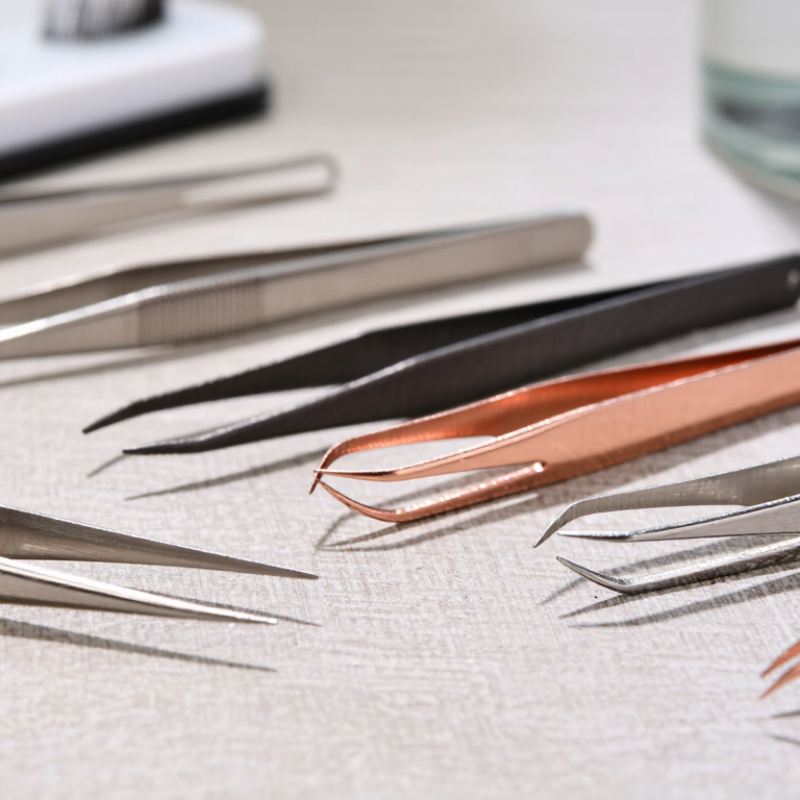
Top Eyelash Extension Tweezers for Professional Use

Lash Extension Diameters: 0.03–0.07 mm Volume vs. 0.10–0.20 mm Classic

Choosing eyelash extension tweezers starts with diameter, not appearance. Volume lashes usually measure 0.03–0.07 mm, while classic lashes commonly range from 0.10–0.20 mm. These differences change grip, fan control, and hand fatigue. A narrow, precision tip helps separate lightweight volume fibers without crushing them. Classic extensions need a steadier pickup point and slightly stronger tension.

Small details matter.

Grand View Research valued the global eyelash extension market at about USD 1.36 billion in 2023, with continued growth expected through 2030. Research and Markets also reports expanding demand for professional lash services. These figures suggest more technicians are handling mixed diameters daily, not just one standard size. However, market growth does not guarantee better technique. Training still matters more than purchasing the most expensive tool.

For 0.03–0.05 mm volume work, I prefer lightweight tweezers with aligned, finely tapered tips. They should close evenly near the tip, not only at the hinge. For 0.06–0.07 mm fans, moderate tension can improve stability.

Classic 0.10–0.15 mm lashes often suit a firm isolation tweezer, while 0.18–0.20 mm fibers may require broader contact. Too much pressure can bend the extension or stress natural lashes. I have found that “perfect” tension varies between hands, so testing several tools remains necessary. Diameter charts help, but they are not commandments.

Choosing Isolation, Straight, Curved, and Boot-Shaped Tweezer Tips

Choosing the right eyelash extension tweezer starts with the tip, not the handle. In professional work, isolation tweezers separate natural lashes cleanly before placement. Their narrow, pointed tips can reach crowded lash lines with control. However, excessive pressure may pinch the client or fatigue your fingers. A lighter touch works better.

Straight tweezers are useful for classic extensions and precise pickup. Their aligned tips offer a clear view of the lash. Curved tweezers follow the eye’s contour and can improve access near inner and outer corners. They often feel more natural during volume work. Boot-shaped tweezers have a wider, angled tip. This shape can grip handmade fans securely without crushing their base. Tip width matters. Very wide tips may hold fans well but reduce precision.

I once chose a tweezer by appearance and regretted it. The tension felt stiff after several appointments. Now I test the grip, closure, and balance before using any tool professionally. Each tweezer should close evenly, without visible gaps at the tip. Clean and disinfect tools according to the manufacturer’s instructions and applicable workplace procedures. Check them often for bent tips or weakened tension. Even an experienced lash artist can miss small damage under bright salon lighting.

Top Eyelash Extension Tweezers for Professional Use - Choosing Isolation, Straight, Curved, and Boot-Shaped Tweezer Tips

Tweezer Tip Type Typical Tip Profile Best Professional Use Recommended Lash Work Main Advantages Possible Limitations Practical Selection Notes
Isolation Tweezers Fine, narrow pointed tips; commonly straight or slightly angled. Separating one natural lash from neighboring lashes before placement. Classic sets, volume preparation, lash fills, and detailed correction work. Provides precise separation and clear visibility around the lash line. Sharp tips require controlled handling and may feel less comfortable for beginners. Choose balanced tension, smooth tip alignment, and a tip fine enough to isolate without snagging.
Straight Tweezers Long, linear gripping tips with little or no curve. Direct pickup, separation, and work in areas where a straight approach is convenient. Classic extensions, single-lash placement, and lash mapping support. Offers a direct sightline and predictable movement for controlled placement. May be less effective around inner corners or when the hand needs to approach at an angle. A narrow, well-aligned tip is useful for classic extensions; moderate spring tension helps reduce hand fatigue.
Curved Tweezers Tips sweep inward in a gradual arc, usually with a fine point. Reaching around the natural lash line and approaching lashes from a comfortable angle. Classic placement, hybrid sets, inner-corner work, and narrow lash lines. Improves access in tight areas and can reduce wrist rotation during placement. The curve can obstruct the view if the angle is too pronounced or the tips are bulky. Match the curve to the technician’s working angle; check that both tips meet evenly along their full contact area.
Boot-Shaped Tweezers An angled, flattened grip area with a broad inner contact zone resembling a boot. Picking up and shaping multiple fine extensions with a stable gripping surface. Volume fans, narrow fans, handmade fans, and some hybrid techniques. Supports consistent fan formation and can hold several lightweight fibers securely. May feel too wide for precise isolation or single-lash work in small inner-corner areas. Select the contact width according to fan size; a smooth, non-serrated grip helps avoid damaging extensions.
L-Shaped Volume Tweezers Distinct angled neck with a short, precise gripping section. Creating volume fans with a controlled pinch or pickup motion. 2D–6D volume fans and narrow, lightweight handmade fans. Combines strong control with a clear working angle for fan manipulation. Requires practice because the pickup point differs from straight or curved tweezers. Useful when the technician prefers a firm pinch; avoid excessive pressure that can close or distort a fan.
Precision Tip Tweezers Very fine, sharply aligned tips designed for small contact points. Detailed correction, adhesive placement support, and precise lash positioning. Classic isolation, corrective work, and difficult lash directions. Delivers high accuracy where a larger gripping surface is unnecessary. Fine tips can bend or misalign if dropped, over-cleaned, or used with excessive force. Inspect alignment before each service and store in a protective case when not in use.

Key Professional Selection Criteria

Selection Factor What to Look For Why It Matters
Tip Alignment Tips should meet evenly without a visible gap or crossing. Even contact improves pickup, isolation, and fan control.
Grip Tension Moderate resistance that closes smoothly without excessive force. Helps maintain accuracy while reducing hand and finger fatigue.
Material and Finish Corrosion-resistant stainless steel with a smooth, easy-to-clean surface. Supports repeated professional cleaning and consistent handling.
Weight and Balance Lightweight construction with the center of balance near the working hand. Improves comfort during long appointments and detailed services.
Cleaning Compatibility A design suitable for approved salon disinfecting procedures. Maintains hygiene without unnecessarily damaging the tool surface or alignment.

Comparing Stainless Steel and Titanium Tweezers for Professional Durability

Top Eyelash Extension Tweezers for Professional Use

Comparing Stainless Steel and Titanium Tweezers for Professional Durability

For professional lash work, tweezer material affects comfort, control, and service consistency. Stainless steel remains a practical choice for many artists. It offers reliable rigidity, precise tips, and easy maintenance. A well-finished pair should close evenly without forcing the fingers. This matters during long appointments.

Titanium tweezers feel noticeably lighter in the hand. That reduced weight may ease wrist fatigue during repeated isolation and volume work. Titanium also resists corrosion well when exposed to moisture and regular disinfection. However, lighter does not always mean better. Some technicians prefer stainless steel because its weight gives steadier placement. Material quality, tip alignment, and hinge tension still matter more than a metal label.

I have used both materials across busy workdays. Stainless steel felt more predictable for classic sets, especially with firm isolation. Titanium felt quicker during detailed volume fans. Small differences became obvious after several hours. Glue residue can damage performance on either type. I clean the tips carefully, follow the disinfectant’s instructions, and dry them completely. Harsh chemicals or poor drying can shorten tool life.

A common mistake is choosing overly sharp tips. They may grip beautifully at first. Later, they can feel unstable or uncomfortable. I still reassess my choice after each service week. Hand pressure, working style, and cleaning habits change the result. Professional durability comes from the alloy and the technician’s routine.

Assessing Tip Alignment, Grip Tension, and 0.5–1.0 mm Contact Precision

Top Eyelash Extension Tweezers for Professional Use

Tip alignment is the first detail I inspect. Under magnification, both tips should meet evenly without crossing or leaving a visible gap. A 0.5–1.0 mm contact area gives better control when isolating one natural lash. Larger contact points may feel stable, but they can reduce placement accuracy. Check the tips from several angles. Alignment can appear correct from above and fail from the side.

Grip tension matters during long appointments. A tweezer should close with steady pressure, not force your thumb into the handle. I test this by picking up a fine fiber repeatedly for five minutes. If my hand tightens, the tension is probably too high. If the fiber slips, it may be too light. That test is practical, but it is not perfect. Different lash techniques require different resistance.

Precision also depends on surface finish and hand position. Smooth inner faces should hold fibers without crushing them. The contact point must stay consistent when the tweezer is angled slightly. I record alignment, tension, and slippage after each trial. My first scoring sheet focused too much on sharp tips. Later, I noticed that comfortable control produced more reliable work. A tiny alignment error can become obvious across a full set. Test before trusting the tool.

Matching Tweezer Ergonomics to 2–3-Hour Professional Lash Services

Top Eyelash Extension Tweezers for Professional Use

Matching Tweezer Ergonomics to 2–3-Hour Professional Lash Services

A two-to-three-hour lash appointment demands more than sharp tips. It requires a tweezer that feels predictable from the first client to the last. In my experience, lightweight stainless-steel tweezers reduce wrist fatigue during repeated isolation work. However, extremely light tools can feel unstable for artists with stronger grip pressure.

Test the tweezer with your hand in a relaxed position. The closing point should respond without force. A narrow, angled tip can improve visibility around the lash line, while a curved volume tweezer may support cleaner fan shaping. Check the tension carefully. If the tweezer snaps shut too quickly, your thumb may work continuously for hours.

Your grip matters.

During longer services, I keep my wrist neutral and rest my forearm on a padded surface. This helps prevent awkward bending near the client’s eye. I once selected a tweezer for its attractive tip shape, but its stiff tension made my thumb sore before the second appointment. That choice looked professional, yet it performed poorly in real use.

Every artist’s hand is different. Finger length, grip habits, and preferred lash techniques change the ideal design. Compare several tweezers during a practice set, not only during a quick store test. Notice slipping, thumb pressure, and tip alignment after thirty minutes. Clean handling and regular inspection also matter, because damaged tips can affect placement accuracy and client comfort.

FAQS

What tweezer diameter suits volume lash extensions?

Volume lashes usually measure 0.03–0.07 mm. Use lightweight tweezers with aligned, finely tapered tips. They should close evenly near the tip. Charts help, but hands differ.

Which tweezers work with classic lash extensions?

Classic extensions commonly range from 0.10–0.20 mm. Straight tweezers offer a clear pickup point. Thicker fibers may need broader contact. Too much pressure can bend them.

How should I choose between isolation, straight, curved, and boot-shaped tips?

Isolation tips separate crowded natural lashes. Straight tips support precise classic pickup. Curved tips follow the eye’s contour. Boot-shaped tips can grip handmade fans securely.

How much tweezer tension is appropriate?

Moderate tension can stabilize 0.06–0.07 mm fans. Firmer tension may suit isolation or thicker classic fibers. Test several tools. “Perfect” tension is not universal.

What should I check before using a tweezer professionally?

Check grip, balance, closure, and tip alignment. The tips should meet evenly without visible gaps. A quick store test may mislead you.

How can tweezers stay comfortable during a two-to-three-hour appointment?

Choose a predictable tool that closes without force. Keep your wrist neutral and rest your forearm on a padded surface. Your grip matters. Very light tools may feel unstable.

How do I reduce hand and thumb fatigue?

Avoid tweezers that snap shut too quickly. Notice thumb pressure and slipping after thirty minutes. A stiff tool can make the thumb sore before the next appointment.

How should lash tweezers be maintained?

Clean and disinfect them according to manufacturer instructions and workplace procedures. Inspect for bent tips or weakened tension. Small damage can affect placement and client comfort.

Conclusion

Choosing the right Eyelash Extension Tweezers is essential for precision, comfort, and consistent results during professional lash services. For volume techniques using lightweight 0.03–0.07 mm extensions, a tweezer with a precise curved or boot-shaped tip can help create and control fans. Classic extensions, typically ranging from 0.10–0.20 mm, may be easier to place with straight or gently curved tweezers. Isolation tweezers should separate natural lashes cleanly without unnecessary pulling or strain.

Professional durability also depends on material, with stainless steel offering reliable strength and titanium providing a lightweight, corrosion-resistant option. Before selecting a pair, check that the tips align evenly and make contact within approximately 0.5–1.0 mm for accurate pickup and placement. Grip tension should feel controlled rather than stiff, especially during services lasting two to three hours. An ergonomic shape, balanced weight, and comfortable finger rest can reduce hand fatigue and support steady technique throughout extended appointments.

Willowayne

Willowayne

Willowayne is a professional marketing specialist with a strong understanding of the company’s products and the needs of the customers who use them. Combining product knowledge with clear, practical communication, Willowayne helps readers understand key features, compare suitable options, and make......