
Choosing a China Top Straight Edge Shaving Razors Manufacturer requires more than comparing prices or viewing polished product photos. A reliable supplier should demonstrate practical experience, stable production, and clear quality controls. Inspect the blade steel, spine alignment, edge consistency, handle finish, and pivot movement. Small details matter. A razor should open smoothly and rest securely in the hand.
Lynn Abrams, a respected straight-razor educator and founder of Straight Razor Place, once offered a useful reminder: “Technique matters more than the price of the razor.” That principle also guides manufacturer selection. Even an attractive Straight Edge Shaving Razors sample may fail if heat treatment varies between batches. Ask for material specifications, inspection records, packaging photographs, and evidence of repeatable production. Request samples from different production runs. One sample is not enough.
The best Chinese manufacturers usually support OEM development, private labeling, engraving, and export-ready packaging. They should also communicate honestly about lead times, minimum order quantities, and acceptable tolerances. A low quotation can hide weak polishing, uneven grinding, or delayed after-sales support. Be careful.
No factory is perfect, and no buyer should pretend otherwise. Minor cosmetic differences may appear during mass production. The real question is whether the supplier identifies them, measures them, and corrects them consistently. This guide examines manufacturers through that practical lens. It considers craftsmanship, documentation, responsiveness, and long-term reliability, helping buyers distinguish genuine capability from attractive marketing language.
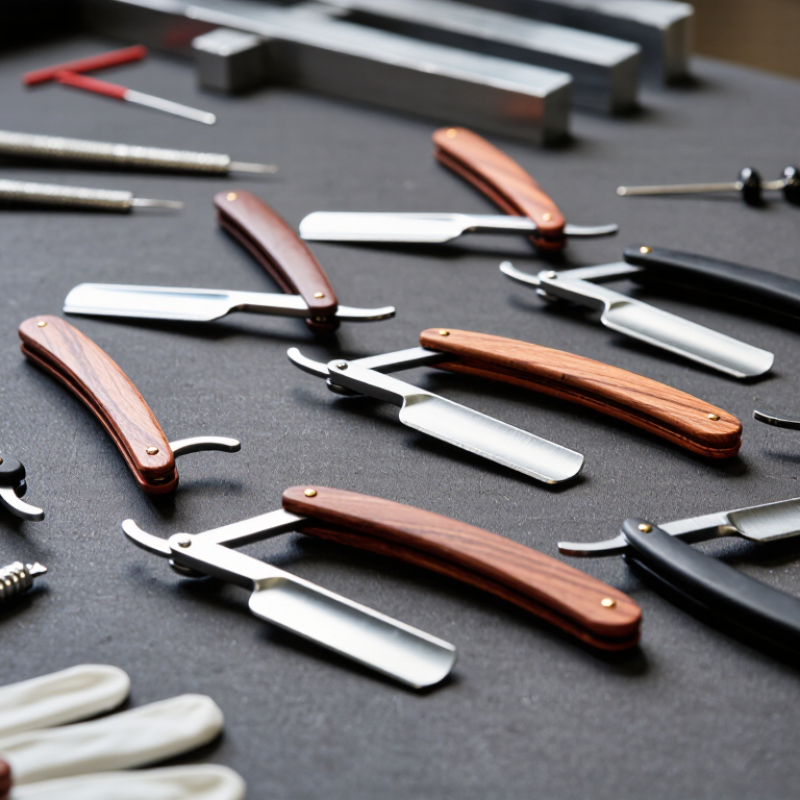
China’s straight edge razor market is shaped by material choice, blade format, and export-ready specifications. Grand View Research places the global razor market at over USD 15 billion, with steady growth through 2030. Straight edge models remain a smaller niche, but workshop demand is visible.
Experienced buyers often choose stainless steel for corrosion resistance and easier cleaning. Carbon steel can provide sharper edge behavior, yet it needs careful drying and protective oil. Common formats include full-hollow, half-hollow, and wedge blades. Blade widths usually range from 5/8 to 8/8 inch. Handle materials include resin, wood, acrylic, and stainless steel. The market is not perfectly standardized. Some suppliers describe grinds differently, so product samples matter more than attractive catalog language.
Tips: Ask for blade steel grade, hardness range, spine alignment, and edge inspection records. Request measurements for blade width, thickness, tang length, and total weight. ISO 8442-1 offers useful guidance for cutlery materials and performance, although it does not define every straight razor detail. China Customs and UN Comtrade data can help verify broader razor trade flows under HS 8212, but straight edge razors are not always separated clearly. That limitation deserves attention. A reliable manufacturer should provide batch records, packaging photos, and pre-shipment inspection options. Small defects, such as uneven grinding or a loose scale, can affect shaving comfort more than buyers expect.
| Product Format | Common Application | Blade or Edge Material | Handle / Scale Material | Typical Overall Length | Typical Blade Length | Blade Thickness or Gauge | Key Manufacturing Specifications | Typical Selling Position |
|---|---|---|---|---|---|---|---|---|
| Traditional Straight Razor | Reusable wet shaving for professional barbers and experienced home users | Hardened carbon steel or stainless steel | Natural wood, resin, acrylic, horn-style synthetic material, or stainless steel | 230–250 mm when open | 60–75 mm | Approximately 0.15–0.25 mm at the spine area, depending on design | Foldable blade, pivoting scales, hollow- or half-hollow-ground edge, hand honing and stropping required | Premium reusable shaving equipment |
| Shavette with Replaceable Blade | Barber line-ups, neck shaving, facial detailing, and hygienic single-client services | Stainless steel disposable blade or half of a standard double-edge blade | Aluminum alloy, stainless steel, ABS, resin, or laminated composite | 210–240 mm when open | 35–45 mm exposed cutting section | Usually about 0.10–0.25 mm, depending on blade type | Blade holder or clamp system, replaceable cutting insert, no stropping or honing of the holder | Professional barber and hygiene-focused format |
| Half-Blade Shavette | Precision edging around beards, sideburns, moustaches, and hairlines | Stainless steel half-blade or snapped double-edge blade | Stainless steel, aluminum, ABS, or zinc alloy components | 190–230 mm when open | 35–40 mm | Approximately 0.10–0.15 mm for many compatible inserts | Compact blade channel, controlled exposure, replaceable blade, easy sanitation between clients | Mid-range professional barber tool |
| Full-Size Disposable-Blade Razor | Barber shaving services where rapid blade replacement is required | Single-use stainless steel blade insert | Stainless steel, aluminum alloy, or reinforced polymer | 210–245 mm when open | 40–55 mm | Approximately 0.10–0.25 mm | Rigid blade support, replaceable insert, corrosion-resistant surface, designed for cleaning and disinfection | Commercial barber-use product |
| Carbon-Steel Straight Razor | Traditional shaving and specialist wet-shaving collections | High-carbon steel with a sharpened and polished edge | Wood, resin, acrylic, or composite scales | 230–250 mm when open | 60–75 mm | Commonly 4/8–7/8 blade-width classifications | High hardness and keen edge potential; requires drying, stropping, and corrosion protection after use | Traditional and enthusiast-oriented product |
| Stainless-Steel Straight Razor | Reusable shaving in humid environments and lower-maintenance product lines | Stainless steel blade, commonly selected for corrosion resistance | Stainless steel, resin, acrylic, or stabilized wood | 230–250 mm when open | 60–75 mm | Commonly 4/8–7/8 blade-width classifications | Resistant to staining and moisture-related corrosion; still requires drying and periodic stropping | Durable reusable product |
| Barber Razor with Guard | Training, controlled facial outlining, and users seeking reduced direct-edge exposure | Stainless steel replaceable blade | Stainless steel, aluminum, ABS, or engineered polymer | 200–240 mm when open | 35–50 mm | Approximately 0.10–0.25 mm | Protective guard or safety lip helps control blade exposure; replacement intervals depend on use and hygiene procedures | Entry-level and safety-oriented barber format |
| Folding Straight Razor | Portable personal grooming and compact storage | Carbon steel, stainless steel, or replaceable stainless steel insert | Metal scales, wood, resin, acrylic, or composite material | 115–130 mm closed; 225–250 mm open | 55–75 mm | Varies by blade construction and grinding method | Folding pivot, balanced scales, secure blade alignment, compact packaging, and protective storage recommended | Portable reusable or gift-oriented product |
| Fixed-Handle Barber Razor | High-volume professional services and quick blade replacement | Disposable stainless steel blade | Stainless steel, aluminum alloy, zinc alloy, or reinforced polymer | 180–230 mm | 35–50 mm | Approximately 0.10–0.25 mm | Non-folding body, rigid blade alignment, replaceable insert, and surfaces suitable for routine disinfection | Practical professional-use product |
| Travel Straight Razor Set | Personal grooming kits, hospitality use, and compact retail packaging | Stainless steel replaceable blade or compact reusable blade | Aluminum, stainless steel, ABS, resin, or synthetic leather case | 180–240 mm when open | 35–65 mm | Approximately 0.10–0.25 mm for replaceable blades | Protective case, compact dimensions, blade storage, moisture-resistant packaging, and clear handling instructions | Travel, promotional, and convenience-focused product |
| Common Quality-Control Points | Applicable across reusable and replaceable-blade formats | Edge uniformity, hardness consistency, and corrosion resistance | Surface finish, scale alignment, fastener security, and handle durability | Measured against approved product drawings | Checked for alignment and allowable tolerance | Verified by drawing, gauge, or incoming inspection | Blade alignment, burr control, pivot smoothness, secure locking, packaging protection, and functional inspection | Factory inspection and buyer acceptance criterion |
440A offers good corrosion resistance and usually supports practical daily use. It may perform reliably around 56–58 HRC. It can forgive small sharpening mistakes.
440C contains more carbon and chromium than 440A. It can support a harder, finer edge around 58–60 HRC. Harder is not always better.
Yes, excessive hardness can make an edge more brittle. Contact with a ceramic sink may cause chipping. Poor honing can also damage the bevel.
No. Heat treatment strongly controls the final result. A 57 HRC blade may feel smoother than a 60 HRC blade. Geometry matters too.
Inspect hardness, edge alignment, spine geometry, and polishing quality. Check the edge under magnification. Test stropping tension. Small defects matter.
Production commonly includes forging, heat treatment, grinding, honing, and polishing. Forging forms the basic profile. Heat treatment controls toughness and hardness. Grinding creates the blade geometry.
Polishing removes surface lines and creates a smoother finish. It should not hide scratches or distortions. A shiny blade can still fail.
Start with minimum order quantities, not catalog photographs. Request pricing for 500, 5,000, and 20,000 units. Ask for pilot samples before mass production.
Request material records, heat-treatment reports, batch traceability, and inspection results. Specify blade thickness, spine alignment, grind angle, and handle fit. One successful sample proves very little.
China’s straight edge razor industry offers a broad range of materials, designs, and specifications for professional barbers, retailers, and private-label buyers. When evaluating Straight Edge Shaving Razors, buyers should review blade formats, handle construction, folding or fixed designs, edge dimensions, and overall usability. Manufacturer qualification should also include documented quality systems and compliance with ISO 8442-4 razor blade safety requirements, helping ensure consistent production and responsible product testing.
Blade steel is another key consideration. 440A can provide balanced corrosion resistance and practical performance, while 440C offers greater hardness and edge retention when properly processed. Typical hardness levels may range from 56 to 60 HRC, depending on the intended application. A reliable production workflow includes forging, heat treatment, grinding, honing, polishing, inspection, and protective packaging. Supplier comparisons should focus on MOQ, dimensional tolerances, certifications, OEM development capacity, sampling procedures, lead times, and communication efficiency to identify a suitable long-term manufacturing partner.