

Executive Sourcing Guide: Selecting Top Jewelry Making Pliers Manufacturers
The global precision craft and high-end jewelry manufacturing sectors demand rigorous structural integrity, exact jaw alignment, and specialized ergonomics from hand tools. When procurement directors and OEM brand managers source from elite manufacturing hubs across China and specialized surgical-tool industrial clusters like Sialkot, evaluating suppliers based solely on unit price introduces catastrophic risks of jaw misalignment, edge brittle fracture, and surface corrosion. This comprehensive whitepaper provides a technical framework for evaluating modern jewelry pliers factories, analyzing metallurgical alloys, precision grinding workflows, and quality assurance standards.
1. Technical Classification of Specialized Jewelry Making Pliers
Jewelry assembly, wire wrapping, and micro-beading demand an array of highly specialized jaw configurations. Understanding the precise engineering tolerances required for each tool variant allows purchasing teams to establish accurate quality control criteria with OEM suppliers:
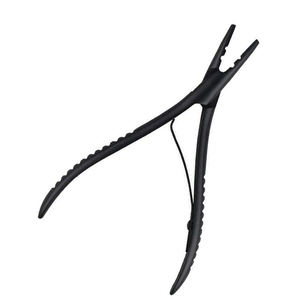
Chain Nose & Needle Nose Pliers
Designed for delicate wire bending, crimping, and opening jump rings. Featuring smooth inner jaws to prevent marring soft precious metals such as 14K gold and 925 sterling silver.
- Tapered conical jaw profile
- Smooth inner surface finish (Ra < 0.4µm)
- Box-joint anti-wobble structure
Round Nose & Bail Making Pliers
Features rounded cylindrical jaws designed to forge uniform loops, spirals, and jump rings. Advanced models integrate multi-tiered stepped barrels for calibrated diameter formation.
- Step diameters: 1.5mm to 8.0mm
- Concentric precision grinding
- Anti-slip satin matte finish
Flush Cutters & Side Cutters
Engineered for razor-clean wire shearing. High-performance cutters feature induction-hardened blades capable of snipping copper, silver, and memory wire without leaving burrs.
- Induction hardened edges (HRC 58-62)
- Micro-flush & full-flush bevel options
- Dual-leaf return spring action
2. Metallurgy Analysis: Stainless Steel Grades vs. High-Carbon Steel
The raw steel composition dictates the long-term shear strength, corrosion resistance, and fatigue life of jewelry pliers. Leading Chinese and international factories leverage distinct metallurgical formulations depending on the operational environment:
| Steel Grade Standard | Hardness Rating (HRC) | Corrosion Resistance | Primary Industrial Application | Quality Certification Tag |
|---|---|---|---|---|
| AISI 420 Stainless Steel | HRC 48 – 52 | Very High (Salt-Spray > 72 hrs) | Cleanroom assembly, high-humidity workshops, precision tweezers & smooth jaws | ISO 9001 Compliant |
| AISI 440C High-Carbon Steel | HRC 58 – 62 | Moderate (Requires light oiling) | Industrial wire flush cutters, memory wire snips, heavy-duty crimpers | DIN EN 10088-2 |
| Chrome-Vanadium (Cr-V 6150) | HRC 54 – 56 | High (When nickel-plated) | General workshop jewelry pliers, mass production craft tools | ASTM A29 Standard |
| Nylon Jaw Polymer Inserts | Shore D 80 | N/A (Chemical Resistant) | Non-marring wire straightening, delicate metal foil forming | RoHS Compliant |
3. Future Procurement Trends in Jewelry Tool Manufacturing (2025–2030)
As global jewelry assembly shifts toward automated production lines and high-speed artisanal studio environments, tool procurement demands are evolving rapidly. B2B buyers must align with factories that incorporate the following forward-looking manufacturing paradigms:
A. Micro-Ergonomic Thermoplastic Rubber (TPR) & ESD Coatings
Repetitive strain injuries (RSI) account for significant downtime in manual jewelry assembly operations. Next-generation pliers feature multi-density dual-dipped TPR handles engineered to absorb shock while offering Electrostatic Discharge (ESD) safety compliant with IEC 61340-5-1 standards. ESD-safe pliers prevent static sparks from damaging micro-electronic embedded jewelry and smart wearable devices.
B. Automated Optical Inspection (AOI) for Jaw Coaxiality
Traditional manual inspection is being replaced by AI-driven vision systems. Advanced Chinese factories utilize sub-pixel optical sensors during final assembly to verify that round-nose concentricity and flush-cutter jaw closure exhibit zero light gaps down to a 5-micron boundary.
C. Non-Marring Surface Coatings & Physical Vapor Deposition (PVD)
With the rise of delicate anodized wire materials and soft precious alloys, traditional steel jaws can leave undesirable micro-scratches. High-end suppliers are applying Titanium Nitride (TiN) and PVD ceramic coatings, which dramatically reduce friction coefficients while extending jaw surface durability by up to 300% compared to standard electroplated nickel.