
Comprehensive Guide: Sourcing Precision Lash Extension Tweezers from China's Leading Manufacturers
The global eyelash extension market has undergone a dramatic transformation over the past decade. As lash application techniques evolve from classic 1:1 application to hyper-dense 10D-20D Mega Volume fans utilizing ultra-fine 0.02mm, 0.03mm, and 0.05mm synthetic mink fibers, the precision requirements placed on lash extension tweezers have reached surgical-level thresholds. For international brand owners, procurement directors, and wholesale beauty tool distributors, identifying a top-tier Chinese lash tweezers manufacturer requires a deep technical understanding of metallurgy, tip closure calibration, anti-static coatings, and quality assurance workflows.
China has firmly established itself as the world’s primary industrial cluster for precision beauty tools and stainless steel implements. By combining advanced CNC micro-machining, automated laser welding, and generationally refined hand-grinding craftsmanship, modern Chinese exporters deliver unprecedented quality-to-cost ratios. This comprehensive industry white paper outlines the core metallurgical standards, product developments, procurement trends, and quality control protocols required when sourcing professional precision lash tweezers.
1. Technical Architecture & Micro-Engineering Standards
Unlike standard eyebrow tweezers or craft forceps, precision eyelash extension tweezers function as microscopic extension instruments for the technician's hands. A micro-alignment variance of just 0.02mm can cause a lash fan to collapse, splitting the adhesive bond and leading to prolonged application times. High-end Chinese manufacturers evaluate tweezers based on three non-negotiable physical metrics:
A. Sweet Spot Closure Efficiency: The "sweet spot" refers to the precise contact zone along the inner blade surface where pressure is evenly distributed. Top manufacturers conduct 100% optical comparator inspections to ensure that when light pressure is applied, the tips close seamlessly with zero light pass-through along a 5mm to 10mm contact zone.
B. Anti-Magnetic & Anti-Static Performance: Static electricity is the enemy of fine synthetic eyelash extensions. Synthetic PBT (Polybutylene Terephthalate) fibers carry electrostatic charges that cause them to jump or stick awkwardly to metal tools. Premium export-grade tweezers utilize non-magnetic Austenitic or specially treated Martensitic stainless steel with anti-static ESD (Electrostatic Discharge) coatings (ESD-10 to ESD-15 ratings), preventing unwanted static interference during delicate isolation and fan placement.
C. Tension Resistance & Spring Rate Stability: A tweezer that is too stiff forces the technician's hand muscles to work excessively hard, causing fatigue within 30 minutes of application. Conversely, a tweezer that is too soft lacks the tactile feedback necessary to feel individual 0.03mm fibers. Premium manufacturers tune internal spring tension through precision cold-rolling processes, maintaining a consistent closure force between 150 and 190 grams.
2. Material Science: Selecting the Right Steel Grade
The selection of raw material directly impacts the tool’s durability, corrosion resistance, and sharpness retention after repeated sterilization. Below is an engineering comparison of the primary stainless steel grades used by top Chinese exporters:
| Steel Grade Standard | Hardness (HRC) | Corrosion Resistance | Magnetic Property | Optimal Application |
|---|---|---|---|---|
| Japanese SUS420J2 | 45 - 50 HRC | High (Martensitic) | Slightly Magnetic | Volume & Fiber-Tip Tweezers (Superior Edge Retention) |
| AISI 304 / SUS304 | 35 - 40 HRC | Exceptional | Non-Magnetic | Isolation Tweezers & Standard Salon Implements |
| AISI 440C High Carbon | 55 - 58 HRC | Moderate to High | Magnetic | Ultra-Fine Micro-Surgical & Curved Tip Tweezers |
| German DIN 1.4116 | 48 - 52 HRC | High | Low Magnetic | Premium OEM Private-Label Barber & Lash Lines |
3. Innovations in Surface Finishing & Ergonomic Grip Technology
Professional lash artists demand tools that not only perform under micro-tolerances but also express brand aesthetics. The global market has transitioned away from basic plain polished stainless steel toward advanced surface finishes:
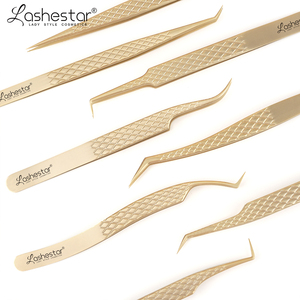
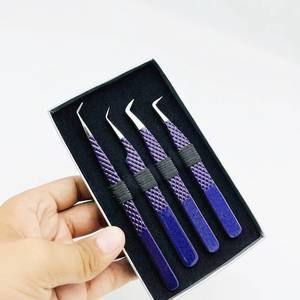
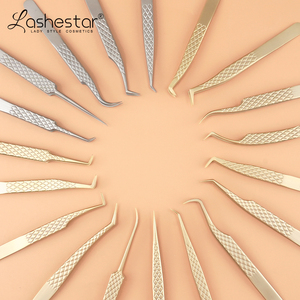
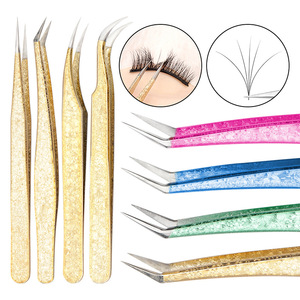
Plasma PVD Vacuum Coating: Physical Vapor Deposition (PVD) creates an ultra-thin, highly durable ceramic-metallic layer on the tool surface. Available in Titanium Gold, Rose Gold, Midnight Black, Rainbow Plasma, and Ice-Pattern effects, PVD coatings increase scratch resistance, eliminate glares from overhead salon lighting, and withstand harsh chemical disinfectants without flaking.
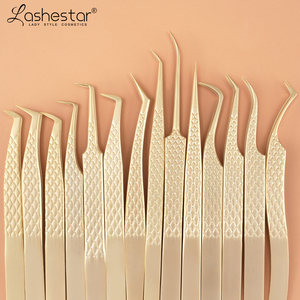
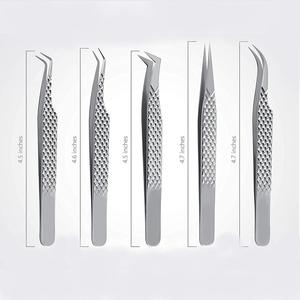
Diamond Grip & Micro-Knurling: For technicians operating in humid salon environments or working with lash cleansers, smooth handles can slip. Etched diamond knurling or laser micro-patterned grips ensure tactile security, giving artists absolute control during high-density volume fanning.
Nano-Grip & Micro-Fibre Tip Etching: The most significant advancement in lash tool technology over the last three years is internal tip micro-etching. By applying a laser-ablated micro-grid to the inside of the tweezer tip, the metal achieves a micro-roughness (Ra value) that securely clamps fine 0.02mm fibers with zero slippage, dramatically shortening lash extension application times.
4. Future Procurement Trends & Strategic Sourcing (2025–2030)
As international supply chains become more sophisticated, B2B buyers must adapt to emerging manufacturing shifts. Key trends defining the future of precision lash tool procurement include:
1. Automated Laser Tip Alignment: Leading Chinese manufacturers are transitioning from manual eye-inspection to automated machine vision alignment systems. High-resolution cameras capture tip geometry from three axes, ensuring that every batch meets a sub-10-micron variance threshold before leaving the factory.
2. Eco-Conscious & Plastic-Free B2B Packaging: Global beauty brands are actively eliminating single-use plastic PVC pouches. Sourcing trends favor recyclable magnetic rigid boxes, FSC-certified paper packaging, stitched vegan leather pouches, and reusable aluminum transit tubes customized with eco-friendly soybean ink printing.
3. Low MOQ Hybrid OEM/ODM Services: To support fast-growing e-commerce brands and specialized lash academies, top exporters now offer flexible private-label customization options. Low minimum order quantities (MOQs starting at 50–100 pieces per style) with custom fiber laser logo engraving allow distributors to rapidly test new tweezer geometries without holding excessive inventory.
5. Factory Quality Assurance & Compliance Protocols
To protect brand integrity and prevent high customer return rates, buyers should verify that their manufacturing partner enforces a comprehensive multi-stage Quality Assurance (QA) workflow:
- Raw Steel Spectrometry Testing: Verifying chemical composition (Chromium, Carbon, Nickel ratios) upon steel coil delivery to prevent premature rusting.
- Submerged Autoclave & Salt-Spray Testing: Subjecting finished coated tools to 72-hour salt spray chambers and repeated high-pressure steam autoclaving to guarantee zero corrosion in professional salon environments.
- The 0.03mm Lash Fan Pick-Up Test: Every individual volume tweezer must pass a manual quality check performed by experienced QC inspectors, picking up 0.03mm 10D fans effortlessly from a silicone strip before receiving packing clearance.
- Batch Serialization: Marking individual tools with discrete batch codes or micro-laser QR markers to enable 100% supply chain traceability in accordance with ISO 9001:2015 quality management systems.